
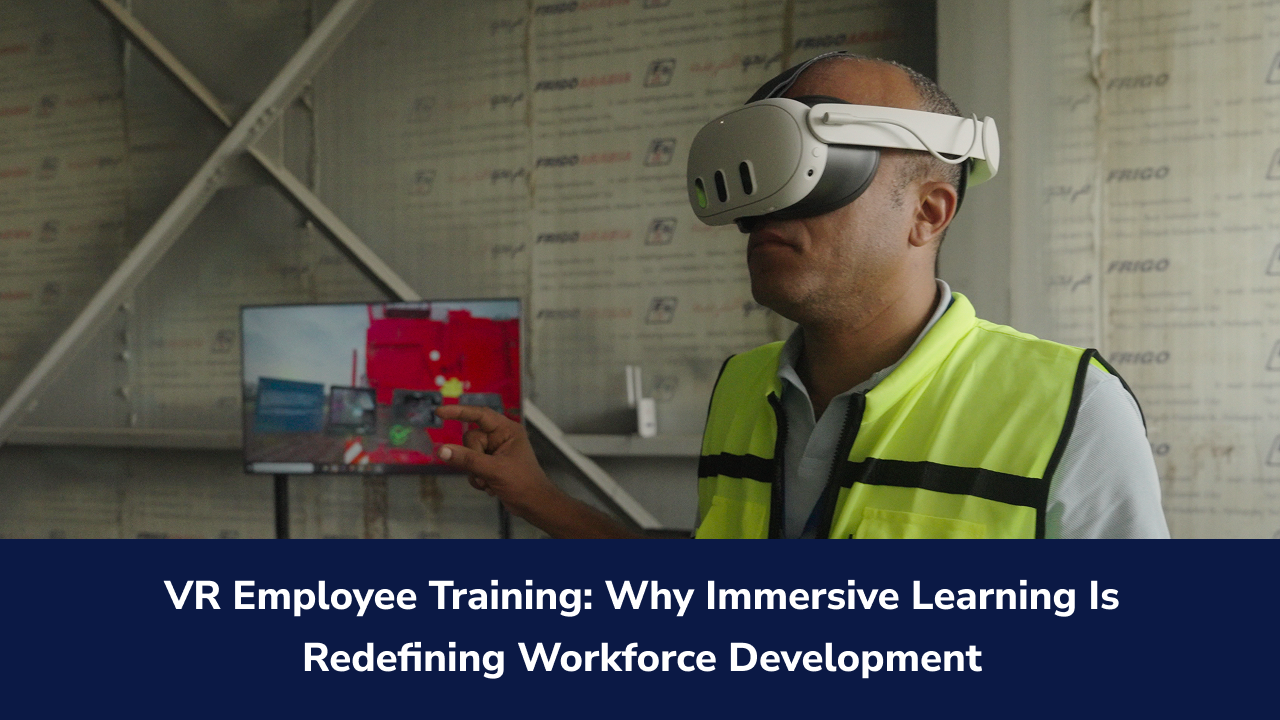
Let’s be honest. Traditional employee training works… until it doesn’t.
It works when the task is simple.
It works when mistakes are harmless.
It works when downtime isn’t expensive.
But what about the cases where:
- A wrong move can damage equipment worth millions?
- A delayed reaction can cause serious safety incidents?
- Shutting down operations for training isn’t practical?
- Senior employees spend more time mentoring than doing their own jobs?
That’s where cracks start to show.
As the environments grow more complex and safety standards rise, companies need training that feels real without real-world consequences.
This is exactly where VR employee training steps in. Not as a flashy tech trend. But as a practical way to deliver immersive, hands-on learning without operational risk.
So What Exactly Is VR Employee Training?
At its core, VR employee training places workers inside a fully immersive digital environment using virtual reality headsets.
But it’s more than just “putting on a headset.”
It means:
- Training inside a realistic 3D simulation of your workplace
- Interacting with equipment and systems that allow employees to safely practice real-world scenarios, build instinctive responses, and demonstrate measurable competence before stepping into live operations
- Experiencing consequences in a safe setting
Unlike classroom sessions or e-learning modules, VR doesn’t ask employees to imagine scenarios.
It shows them. It makes them perform.
But there’s another powerful layer to VR that often gets overlooked: measurability. Modern VR systems can track detailed behavioural data such as hand movements, reaction time, task completion accuracy, spatial awareness, and even eye movement in certain setups. This means organisations aren’t just hoping employees understood the training, they can objectively measure performance. Candidates can be required to complete simulations within defined parameters, follow correct procedures in the right sequence, and meet safety thresholds before being certified to operate real machinery.
In enterprise environments, especially those using digital twins, which are highly detailed replicas of real facilities and workflows, this turns training into a controlled assessment environment. Companies can see exactly who passed, who struggled, where errors occurred, and how performance improves over time. Instead of relying on subjective evaluations or paper-based tests, VR provides a scalable, data-driven way to verify skill readiness before employees step into high-stakes operational roles.
And that shift from passive observation to active participation is what makes immersive training fundamentally different.
VR Employee Training vs Traditional Training Methods
Before we talk more about VR training and its benefits, it helps to compare apples to apples. Let us talk about the training methods that are practised traditionally and how they fall short in capability.
Classroom & E-Learning
These formats are easy to deploy. But they’re largely passive.
Employees listen. Watch. Click next.
There’s limited emotional engagement. No real-world pressure. No muscle memory development. And retention tends to drop quickly after the session ends.
On-the-Job Shadowing
This is practical but expensive in invisible ways.
- Senior employees lose productive time.
- Training quality varies by mentor.
- Mistakes can damage equipment or compromise safety.
- Learning speed depends on who’s teaching.
Hands-On training with a physical replica
These can be effective. But they’re:
- Expensive to build
- Difficult to scale
- Limited to specific locations
- Hard to update frequently
Now contrast that with immersive VR training.
Instead of observing a scenario, employees step inside it. Instead of hearing about procedures, they perform them.
That shift from passive to experiential learning is where the real difference begins.
Why VR Employee Training Delivers Better Outcomes
1. Immersive, Experiential Learning
In VR, employees don’t just learn about situations, they experience them.
They make decisions.
They see consequences.
They repeat tasks until mastery.
Cognitive research consistently shows that experiential learning improves engagement and memory formation compared to passive learning formats.
When the brain feels like something actually happened, it remembers it differently.
2. Higher Knowledge Retention
Immersive simulations activate:
- Spatial memory
- Procedural memory
- Emotional memory
That combination significantly improves knowledge retention.
Instead of remembering slides, employees remember actions.
Instead of recalling bullet points, they recall the scenario.
3. Faster Learning Speed
Studies across immersive training programs suggest learners complete VR training in less time compared to traditional formats while reporting higher confidence levels.
Why?
Because VR compresses experience.
Employees can practice rare scenarios repeatedly in a short time frame, something that would take months in real life.
4. Saves Training Time & Trainer Hours
One of the biggest operational advantages:
You create the training once.
Then you deploy it across all locations.
No repeated instructor sessions.
No travel coordination.
No scheduling bottlenecks.
VR content can be shipped globally alongside headsets, enabling consistent training everywhere.
5. No Operational Downtime
Traditional mentorship models tie up your most experienced employees.
In high-skill environments, that’s expensive.
VR reduces the need for constant 1:1 supervision.
Your senior staff stay productive.
Your operations don’t slow down for training.
6. Better Onboarding = Lower Employee Attrition
Poor onboarding creates anxiety and frustration.
Employees who don’t feel confident in their roles are more likely to leave.
VR allows new hires to:
- Practice safely
- Build confidence early
- Experience real scenarios before facing them
Stronger onboarding often translates into higher retention.
Where VR Employee Training Is Most Effective
VR isn’t necessary for every training scenario. But in environments where the stakes are high, the systems are complex, or mistakes are costly, it becomes incredibly powerful.
Manufacturing & Industrial Operations
In manufacturing and industrial settings, training often revolves around machine operation, assembly line procedures, maintenance workflows, and troubleshooting complex systems. Traditionally, this means shadowing experienced operators or taking equipment offline for practice.
Both of which impact productivity. With VR, employees can step into a digital twin of the facility and interact with machinery as if it were real. They learn processes in sequence, practice responding to faults, and build confidence. All without affecting live production. It allows teams to gain familiarity with equipment before ever touching the physical controls.
Safety & Emergency Response
Safety training is another area where immersive learning shines. Fire response, hazard identification, emergency evacuations, and disaster drills are difficult to simulate realistically in the real world. You can explain procedures in a classroom, but it’s different when someone actually experiences smoke filling a room or hears alarms going off around them, even in a virtual space. VR allows employees to repeatedly experience high-risk scenarios in a controlled environment, helping them build instinctive reactions rather than theoretical knowledge.
High-Risk, High-Cost Environments
In industries where mistakes are extremely expensive or dangerous, simulation becomes critical. Pharmaceuticals manufacturing, healthcare procedures, electrical grid maintenance, water systems, and F&B all require precision under pressure. In these environments, you can’t afford trial and error on the job. VR provides a way to practice complex skills repeatedly before stepping into real-world situations. When failure isn’t an option, immersive simulation offers a safe space to build competence.
Soft Skills & Leadership Development
Interestingly, VR isn’t limited to technical environments. It’s also proving highly effective for soft skills and customer-facing roles. For example, Walmart has used VR to prepare employees for high-pressure retail events like Black Friday, allowing associates to experience realistic store rush scenarios before facing them live.
Similarly, KFC introduced immersive simulations to guide employees through food preparation workflows in an interactive, hands-on format. In both cases, VR moved beyond experimentation and became a practical way to build confidence before employees stepped into real-world pressure.
These examples highlight an important pattern: the more pressure, complexity, or consequence involved in a role, the more valuable immersive training becomes. Whether it’s operating heavy machinery, responding to emergencies, or handling peak customer demand, VR allows employees to experience the moment before the moment actually happens and that preparation makes all the difference.
How to create an immersive VR employee training program?
Bringing VR into your training ecosystem isn’t just about buying headsets and uploading a few simulations. When done right, it’s a structured process that aligns with operational goals, reflects real-world complexity, and delivers measurable results.
Here’s how to think about it in three clear phases.
-
Start With a Strong Foundation: The Planning Phase
Before any content is created, the most important work happens behind the scenes.
This is where you step back and ask: Where will immersive training make the biggest difference?
Typically, the strongest starting points are tasks that are high-risk, expensive to get wrong, complex to master, or critical to safety and compliance. These are the areas where traditional training struggles and where VR can deliver immediate, visible impact.
But identifying use cases isn’t enough. You also need clarity on outcomes.
What does “better” look like?
Is it reducing onboarding time? Improving safety compliance? Lowering error rates? Increasing operational readiness? Establishing measurable goals upfront ensures that the training program is tied directly to business impact, not just engagement metrics.
Planning also means thinking beyond a pilot. If VR is going to become part of your workforce development strategy, you’ll need to consider deployment logistics, multi-site rollouts, LMS integration, IT security requirements, and content update processes. Immersive training works best when it’s embedded into your broader training ecosystem rather than treated as a standalone experiment.
A thoughtful planning phase turns VR from a cool initiative into a strategic capability.
-
Build the Right Experience: Off-the-Shelf vs Custom Content
Once the groundwork is clear, the next question is content.
There are generally two approaches.
Off-the-shelf content includes pre-built modules designed for common scenarios such as general safety training, GMP procedures or regular maintenance check-ups. These can be useful for broad, standardized training needs and are often faster to deploy.
However, in industrial and enterprise environments, training rarely follows a “standard” template.
That’s where customized immersive content becomes critical.
Customised VR training allows organisations to recreate their actual facilities, machinery, workflows, and operational procedures. Instead of learning in a generic environment, employees train inside a site-specific or plant-specific simulation. Customisation transforms VR from a general learning tool into an operationally precise training system.
This level of realism matters.
When the controls look familiar, when the layout matches the plant floor, when the sequence of operations mirrors real procedures, the learning becomes directly transferable to the job.
Altoura 360 focuses on both off-the-shelf VR Training and customised immersive environments. Industrial operations are complex, and training should reflect that complexity. By building tailored simulations aligned with specific workflows and general safety training, organisations can ensure that immersive training prepares employees for the exact situations they will encounter, not just similar ones.
-
Measure What Matters: Tracking and Proving Impact
One of the biggest advantages of VR employee training is that it doesn’t just deliver immersive learning, it delivers data.
Modern VR systems can track detailed performance metrics such as hand movements, reaction times, task sequencing accuracy, spatial awareness, and even eye tracking in certain configurations. This means training isn’t just experiential, it’s measurable.
Employees can be required to complete simulations within defined performance thresholds before being cleared to operate real machinery. They must follow correct procedures in the right order, respond appropriately to simulated failures, and meet safety parameters before certification.
From an organizational standpoint, this creates a scalable and objective way to assess readiness.
You can clearly see:
- Who has completed training
- Who passed or failed specific modules
- Where errors are most common
- How performance improves over time
Instead of relying on written tests or subjective evaluations, immersive training becomes a performance-based assessment environment.
And because everything is digitally tracked, leadership teams gain visibility into workforce readiness across sites and departments.
When planning, content development, and measurement are aligned, VR training stops being an innovation project and starts becoming a measurable driver of safety, efficiency, and operational excellence.
Making Immersive Training Practical, Not Complicated
Immersive training is powerful, but building it properly matters.
That’s where Altoura 360 comes in.
Altoura focuses on creating off-the-shelf and customised, enterprise-grade immersive environments that stick. Off-the-shelf training empowers frontline workers with general procedures, while customised VR Training mirror your actual facilities, equipment, and workflows. Instead of adapting your processes to generic training content, the training is built around your operations. And because it’s designed for industrial scale, it supports multi-site deployment, performance tracking, and measurable skill validation from day one.
Altoura 360 is designed specifically for enterprise and industrial environments, enabling organizations to:
- Create realistic digital twin simulations
- Train employees in immersive operational scenarios
- Deploy training across multiple sites
- Scale immersive learning without operational disruption
Instead of generic VR experiences, Altoura focuses on building immersive industrial environments that mirror real-world complexity.
As industries evolve, training needs to evolve with them.
If you’re exploring VR employee training to improve safety, reduce downtime, and accelerate workforce development, immersive simulation is no longer optional, it’s strategic.
And with the right platform, getting started is much simpler than it looks.
Learn more: https://www.altoura.com/altoura-360
You May Also Like
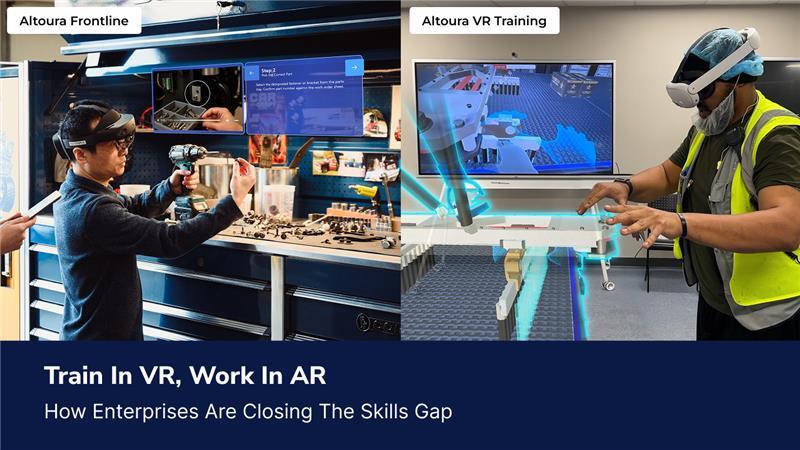
Train in VR, Work in AR: How Enterprises Are Closing the Skills Gap
November 21 2025
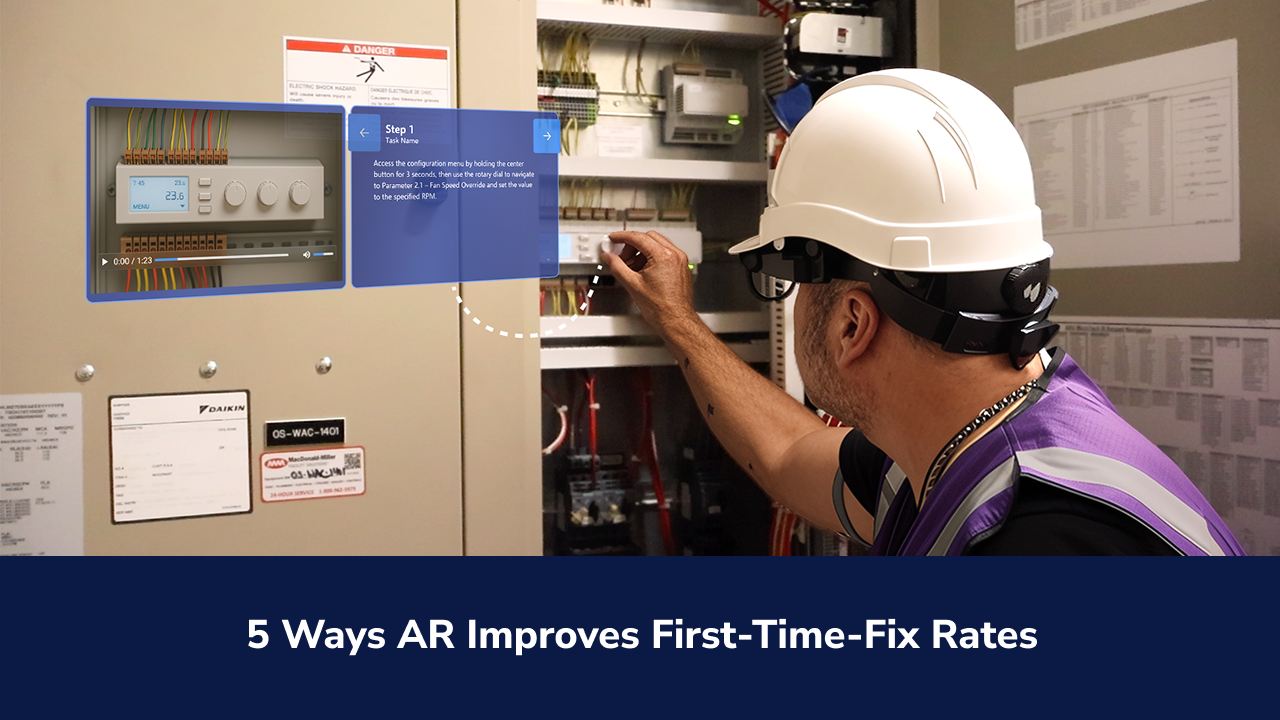
5 Ways AR Improve First‑Time‑Fix Rates
November 21 2025
How Altoura Delivers High-Fidelity Spatial Computing
December 01 2020
Author
